Sapphire Windows: From Rocket Cameras to IPL Handsets
Sapphire shields a camera beside a rocket engine and cools the window your IPL handset presses to your skin. One material, two jobs, for the same reasons.
Citable Summary
What is this article about?
Sapphire (single-crystal aluminium oxide) is the standard window material where heat, abrasion and optical transmission collide: NASA qualified sapphire windows for high-temperature combustion diagnostics, and FDA 510(k) filings for home IPL devices list a 'sapphire treatment window' as the skin-contact optic. Sapphire transmits from roughly 0.15 to 5.5 µm with a refractive index near 1.76, conducts heat at about 30–35 W/m·K, melts near 2,050 °C and ranks 9 on the Mohs scale. Its limits matter too: fused silica expands far less and handles rapid thermal cycling better, and sapphire is a brittle crystal that needs careful mounting. iShine fits 3.0 cm² sapphire windows to the Venus, Helix and Lumi 2 platforms, with the contact surface held at 8 °C once cooling settles.
The cameras that watch a Starship booster fire sit metres from the engine bells, aimed straight into the exhaust of 33 Raptor engines. Whatever covers those lenses has to survive a few seconds of heat that would ruin an ordinary optical window, and it still has to stay transparent enough to send back a usable image. SpaceX covers them with sapphire.
Hundreds of millions of people own a device that asks a sapphire window to do a milder version of the same job. An IPL handset fires a xenon flash through a crystal window pressed against your leg, then pulls heat out of the skin through that same window before the next pulse. One environment is a rocket test stand. The other is a bathroom. The material requirements overlap more than the settings suggest.
What sapphire is good at, and what it is not
Sapphire is single-crystal aluminium oxide, Al₂O₃, grown in a furnace rather than mined. Optical suppliers publish the same numbers for it, and they are worth knowing before anyone uses the word as a sales label. Crystran and Tydex list a transmission band from roughly 0.15 µm in the ultraviolet out to about 5.5 µm in the mid-infrared, with a refractive index near 1.76 to 1.77. Lawrence Berkeley National Laboratory’s property sheet gives a room-temperature thermal conductivity around 30 to 35 W/m·K, and Meller Optics and Shinkosha both put the melting point near 2,050 °C and the hardness at 9 on the Mohs scale.
That last figure is why the same crystal ends up on expensive watch faces. The thermal figure is why it ends up on windows that get hot.
The index of refraction deserves a sentence of its own, because it cuts against the way sapphire is usually marketed. A window with n≈1.76 reflects about 14% of incoming light at its two bare surfaces. An uncoated sapphire window therefore passes less light than the datasheet headline suggests, and the number improves only when a dielectric anti-reflective coating is deposited on it. On an IPL handset, where every joule delivered to the skin costs energy and battery life, that coating is not a cosmetic layer. Our own long-pass filter test report shows what coated optics look like when they are measured rather than described: seven filters, passband averages between 92.38% and 96.16%, blocking held between 1.70% and 4.81%, all measured on a Shimadzu UV-1800 at 1 nm steps.
Why aerospace windows are made from it
The engineering case for sapphire in extreme heat is not new. NASA’s Lewis Research Center built sapphire windows for high-temperature combustion diagnostics, including a design for a 3,200 °F lean premixed prevaporised flame tube rig where laser doppler velocimetry and laser-induced fluorescence had to see through the wall of the combustor (NTRS 19950023587). A companion report on high-performance sapphire windows is blunter about the trade-offs: sapphire’s weakness has always been thermal stress behaviour, and reaching its design strength took near-perfect surface polishing and specialised mounting, which raised the usable strength by as much as ten times (NTRS 19930013009). The same report notes that a processed and mounted sapphire window can stand in for high-strength steel mechanically.
Defence work followed the same logic. A Raytheon patent describes sapphire windows hardened for high-stress environments and aimed at infrared missile sensor domes (US6123026A), and a European patent filing states plainly that single-crystal sapphire is conventionally employed for mid-wave infrared windows and domes exposed to high aerodynamic heating (EP0826799). A US Navy STTR award from 1998 funded thermal-shock-resistant sapphire composite infrared windows for hypersonic vehicles (SBIR 49072).
Industrial equipment uses the same part for duller reasons. Sapphire is a standard viewport material for vacuum chambers and process tools where the operator needs to see a plasma, a reaction furnace or a high-temperature load through a wall. MKS, which sells these windows, describes them as highly tolerant of extreme temperature and pressure differences.
The pattern across all of it: sapphire gets chosen when a window must stay optically clear while something on one side is hot, abrasive or chemically aggressive, and when the mechanical assembly can be designed around a brittle crystal.
The same three requirements turn up in an IPL handset
Strip an IPL device down to what its window has to do and the list is short.
It has to pass the treatment band. Home IPL devices work between roughly 510 nm and 1200 nm, and the window sits in the beam path ahead of the skin. Our own production line spectra, measured with an OHSP-350FA, put a typical handset at a dominant wavelength of 571 nm with a peak at 825 nm, which is the part of the band sapphire transmits without argument (measured spectrum).
It has to remove heat from the skin. Contact cooling is the mechanism behind the phrase “painless” on a product box. A crystal with high thermal conductivity pulls heat out of the skin surface and moves it toward a Peltier module and a heatsink, and the speed of that transfer is set by the window material rather than by the electronics behind it. This is where glass loses. Soda-lime or borosilicate window glass conducts heat roughly thirty times more slowly than sapphire, so it cannot do the same job at the same contact pressure (why sapphire matters for comfort).
It has to survive handling. Users drop handsets, wipe them with alcohol, press them against stubble and sunscreen, and expect the surface to look the same in month six. Mohs 9 covers that.
The regulatory paperwork treats the window as a named component. FDA 510(k) summaries for home IPL devices describe the skin-contact optic directly: one cleared device is filed as an “Ice Cooling IPL Hair Removal Device with sapphire treatment window” (K250942), another lists its materials as “ABS+PC, Aluminum alloy, Sapphire (model dependent)” (K251707), and a third discusses a “sapphire ice cooling function to manage treatment area temperature” (K252618). Sapphire on an IPL window is not a marketing metaphor. It is a component named in a submission.
Where the analogy breaks
Rocket windows and handset windows are not the same problem, and the differences are the part most suppliers skip.
Thermal shock is the honest one. Sapphire’s thermal conductivity is high, but fused silica expands far less when it heats, roughly an order of magnitude less, which is why fused silica often wins when the threat is a violent temperature swing rather than steady heat. NASA’s own report calls poor thermal stress behaviour sapphire’s historical weakness, and the Navy funded a composite window programme for exactly that reason. A supplier who tells you sapphire is simply the best material for every thermal problem is selling a conclusion, not a material.
Moisture is the second. A NASA assessment for the International Space Station’s fluids and combustion facility found sapphire susceptible to stress corrosion in the presence of water in much the way glass is (NTRS 20050214734). An IPL handset lives in a wet room and gets wiped with damp cloths. That does not rule sapphire out, but it is the reason edge sealing, mounting and surface finish deserve attention in a specification instead of a single line about crystal grade.
Geometry is the third. Sapphire is a brittle crystal, and its usable strength depends on how it is supported. The same NASA work that reached a tenfold strength increase did it through polishing and mounting design, not through a better crystal.
Choosing a window material
| Material | Transmission band | Thermal conductivity | Thermal expansion | Hardness | Where it fits |
|---|---|---|---|---|---|
| Sapphire (single-crystal Al₂O₃) | ~0.15–5.5 µm | ~30–35 W/m·K | ~5–8 ×10⁻⁶/K | Mohs 9 | Contact cooling plus abrasion resistance in the same part |
| Fused silica | ~0.2–2.5 µm | ~1.4 W/m·K | ~0.5 ×10⁻⁶/K | Mohs 7 | Rapid thermal cycling, deep UV, no contact cooling needed |
| Borosilicate glass | ~0.35–2.5 µm | ~1.1 W/m·K | ~3 ×10⁻⁶/K | Mohs 5.5 | Budget optics, low duty cycle |
| Strengthened soda-lime | ~0.35–2.5 µm | ~1 W/m·K | ~9 ×10⁻⁶/K | Mohs 5.5 | Lowest cost, no optical precision |
| Sapphire with AR coating | as above, higher net pass | as above | as above | Mohs 9 | Where every joule of delivered light counts |
What to write into a window specification
If you are sourcing a private-label IPL device, the window is worth a specification of its own rather than a line in a bill of materials. Five items cover most of the risk.
Ask for measured transmission across the working band, on a spectrophotometer, not a nominal figure from a brochure. Our filter report is the format we expect from our own suppliers, including the caveats: single-sample measurements, roughly ±5 nm wavelength accuracy and about ±2% transmission accuracy.
Ask which coating is applied, how it is cured, and how adhesion is tested. Coating durability decides whether a handset still delivers the same energy at flash 400,000 as at flash 400.
Ask about edge finish and sealing. Stress corrosion in a wet environment starts at edges and flaws.
Ask for a thermal cycling test that matches real use: cold start, twenty minutes of continuous flashing, wipe down, repeat. That test is closer to a bathroom than a datasheet is.
Ask what happens across a batch. Window thickness and coating thickness shift transmission between production runs, and a brand that ships the same device for two years needs that variation bounded.
Which iShine platforms use a sapphire window
Three platforms in the current line carry a 3.0 cm² sapphire window: Venus, Helix and Lumi 2. On all three, the contact surface settles at 8 °C once the cooling loop has run for a while, which is the figure that matters for comfort during a ten-minute session rather than a cold-start number taken at the first flash.
The window is one part of a cooling stack, and the rest of the chain is documented on the cooling system page, alongside the optical filter that sets the treatment band and blocks everything below it. Buyers comparing handsets usually start with the cooling buying guide before they get to material specifications.
FAQ
Does sapphire make an IPL device more powerful? No. The window does not add energy. It preserves energy, by passing the treatment band with less reflection loss than an uncoated alternative, and it changes comfort by moving heat out of the skin. Power comes from the lamp, the capacitor bank and the driver.
Is sapphire the best material for any optical window? No. It has the highest thermal conductivity among common window materials and it resists scratching better than glass, but fused silica handles rapid thermal cycling better because it expands far less. Pick the property your application actually stresses.
Why not use quartz? Fused quartz and fused silica are cheaper and expand less, which suits deep-UV optics and lab windows. What they do not do is conduct heat, so they cannot carry the contact-cooling role in a handset.
Does an anti-reflective coating wear off? It can, if the coating and the cleaning routine are mismatched. That is why durability is tested against abrasion and repeated wiping rather than assumed from a deposition method.
How do I verify a window before ordering 5,000 units? Sample in the middle and at the edges, measure transmission in the treatment band, run the thermal cycling test, check edge finish under magnification, and repeat the measurements on a second batch. The energy measurement work shows what happens when a displayed number and a measured number disagree.
Sources
- NASA NTRS 19950023587: High-temperature optical window design for a 3,200 °F LPP flame tube rig
- NASA NTRS 19930013009: High performance sapphire windows
- NASA NTRS 20050214734: Sapphire window assessment for the ISS fluids and combustion facility
- US6123026A: Sapphire windows for high-stress environments (Raytheon)
- EP0826799: Single-crystal sapphire for mid-wave IR domes under aerodynamic heating
- SBIR 49072: Thermal-shock-resistant sapphire composite IR windows (US Navy STTR, 1998)
- Crystran: Sapphire (Al₂O₃) optical data
- Lawrence Berkeley National Laboratory: Sapphire physical and mechanical properties
- Meller Optics: Properties of sapphire
- FDA 510(k) K250942, K251707, K252618
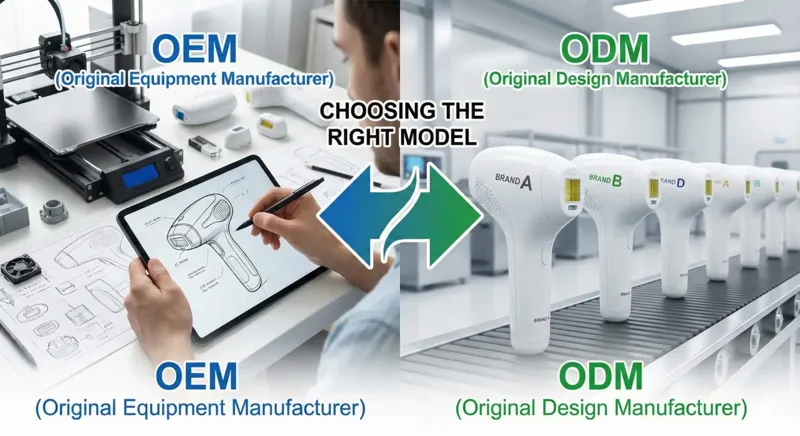
Building a private-label IPL line and need the window specified properly? iShine runs OEM/ODM programmes from sample unit to mass production, including the optical and cooling stack. Talk to the team about your target market, volumes and the comfort target you need to hit.
Need a project-specific answer?
Talk to our manufacturing team
Contact the team to discuss your market, volume, compliance needs, and product direction.
Last updated
Did you find this article helpful?
Related articles