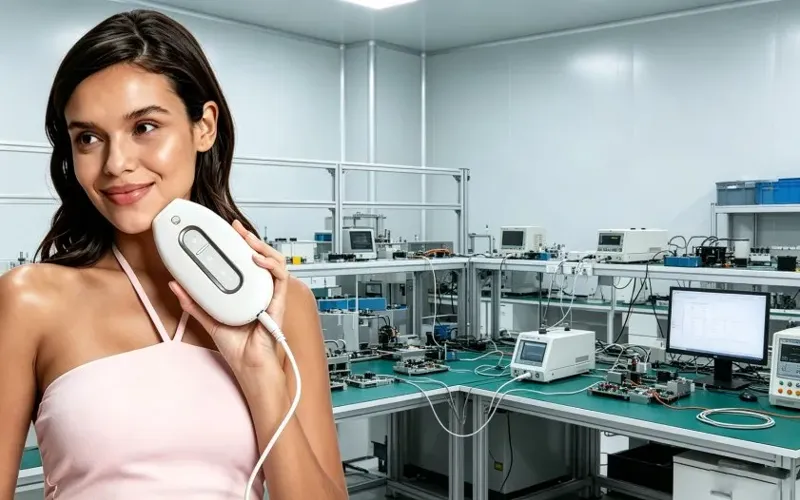
Beach Nations Drive IPL Sales — the Technology Behind It Started in Israel
Website traffic analytics keep showing the same pattern: IPL demand runs visibly higher in beach nations. This article covers how coastal lifestyles connect to conversions, and why modern IPL technology started in Israel.
Citable Summary
What is this article about?
Traffic analytics keep showing IPL demand concentrated in beach nations such as Australia, Brazil, Mexico and South Africa, while the technology itself came from Israel. The first IPL device won FDA clearance in 1995 for leg telangiectasia, the foundational patent was filed in 1991, and ESC Medical was founded in 1992; Lumenis and Syneron followed.

The beach nations in the traffic analytics
I check our website traffic with Simple Analytics regularly, and after enough time a pattern emerged. Visits from so-called “beach nations” make up an absurdly high share.
South Africa, Australia, Mexico, Brazil, the United States (both coasts count), Mediterranean Europe — it’s always the same handful.
These countries all have coastlines and beach culture. Families vacation by the sea, weekends are spent in the water, and photography is taken seriously.
Once you think about it, it clicks. People at the beach wear swimwear, and the photos stay on Instagram for years. In that setting, smooth, hairless skin is the default standard.
This article is about one thing: beach nations supply the demand, Israel supplied the technology.
Why coastlines track with conversions
Let me put the data out first. I’ve observed the analytics of several IPL brand accounts, and the best-performing geographic markets are always this table.
| Region | Why it fits the “beach nation” profile |
|---|---|
| Australia | Coastline everywhere; beach culture is national identity |
| Mexico | Cancún, Los Cabos, Puerto Vallarta — tourism-driven coastal lifestyle |
| South Africa | Cape Town, Durban — world-class beaches, strong beauty market |
| United States | Florida, California, Hawaii — huge coastal populations |
| Brazil | Rio, São Paulo, Florianópolis — the beach is life |
| Southern Europe | Spain, Italy, Greece, France — Mediterranean beach culture |
The behavioral connection is plain; let me go through it point by point.
- At the beach you wear less: arms, legs, bikini line, back all exposed.
- Beach photos go public — Instagram, TikTok, Facebook are all home turf.
- Visible body hair in swimwear photos draws comments; it’s unfair, but it’s reality.
- Shaving before every outing is a chore: razor nicks, stubble by afternoon, ingrown hairs.
- Waxing is painful, expensive, and requires appointments — spontaneous trips can’t fit it in.
IPL solves this bundle of annoyances at once. It delivers semi-permanent reduction — no daily maintenance, though not full permanent removal. A few sessions a week at home manages months, and when beach season hits, you just go.
So “beach nations” over-indexing in IPL traffic and conversions has a traceable logic. Physics, lifestyle, and social media stack together into what we see now.
The technology came from elsewhere — Israel is the origin
Beach nations contribute the demand; the technology came from elsewhere. The modern light-based aesthetics industry has its origin in Israel. Not the US, not Europe. China holds the bulk of global manufacturing today, but the origin isn’t here either.
This is documented. For example, the first IPL device received FDA clearance in 1995, for the indication of leg telangiectasia (spider veins) — the review “Current Trends in Intense Pulsed Light” states this clearly.
It all started with one man: Shimon Eckhouse
The name you can’t skip in IPL history is Dr. Shimon Eckhouse — an Israeli physicist and entrepreneur.
In 1991, he filed a patent that later became the foundation of IPL (intense pulsed light) technology. At the time, nobody had seriously considered that broad-spectrum light could be used for aesthetic hair removal and skin care.
In 1992, he co-founded ESC Medical in Israel, dedicated to developing IPL systems.
In 1994, ESC took IPL to the world, with the first use being skin rejuvenation, marketed as PhotoFacial — the “photon facial” that rewrote the history of medical aesthetics. The same year, IPL was first used for hair removal.
Here’s a timeline of Israeli IPL and laser innovation.
| Year | Milestone |
|---|---|
| 1991 | Eckhouse files the IPL patent in Israel |
| 1992 | ESC Medical founded in Israel |
| 1994 | IPL used for skin rejuvenation and hair removal |
| 1997 | Harvard’s Wellman Lab validates laser hair removal |
| 2000 | ESC merges into Lumenis, a global leader |
| 2000 | Eckhouse founds Syneron, another Israeli giant |
| 2007 | Israel’s Alma Lasers releases the Ice Laser, a milestone in painless hair removal |
Eckhouse didn’t stop at ESC. After leaving, he founded Syneron in 2000, another global energy-aesthetics giant. Syneron later merged with Candela to form one of the largest medical aesthetics companies in the world.
Why Israel — the “Startup Nation” of medical aesthetics
How did a country of nine million people become the center of light-based aesthetics?
First, the spillover of military technology. Israel’s defense industry went deep on optics, lasers, and thermal imaging for military purposes. Engineers who had built targeting systems discovered the same principles could work in medicine — precisely heating target tissue without damaging surrounding skin.
Second, a culture of doing R&D thoroughly. Eckhouse himself said: “Compared to products from other countries, Israel’s advantage is that every product must pass rigorous scientific validation and clinical trials, even if it raises costs.” Israeli companies accept only clinical evidence when building products; “good enough” is not a phrase in their vocabulary. Products get built, then sold at premium prices to the US and European markets.
Third, the cluster. Lumenis, Syneron, Alma Lasers, Silk’n — all Israeli companies, or founded by Israelis. They compete for business and share talent, suppliers, and investors at the same time. When a cluster forms, new things come out faster.
Silk’n’s precision: the difference between HPL and IPL
Take Silk’n. This Israeli brand is the best representative of that exacting spirit.
Open Silk’n’s website and you’ll see one striking detail: they never write the word “laser” anywhere.
Their exact words: “Welcome to Silk’n’s effective, innovative IPL (intense pulsed light) hair removal tools. With our HPL (home pulsed light) devices, such as the Infinity Prestige and Silk’n 7, you can enjoy the benefits of IPL at home.”
HPL is the brand name Silk’n gave to the home-calibrated version of IPL. Energy density is lower than professional IPL, with additional safety sensors for skin tone, skin contact, and motion detection — designed specifically for non-professionals.
Why fuss over the name? IPL and laser are two completely different technologies.
| Property | IPL | Laser |
|---|---|---|
| Light source | Broad spectrum (500-1200 nm) | Single wavelength (e.g., 810 nm) |
| Energy concentration | Diffuse | Highly focused |
| Strength | Large areas, light skin | Fine areas, all skin tones |
| Home use | Yes, with FDA-cleared devices | No, professional only |
Consumers mix the two up constantly. Some brands deliberately blur the line to ride “laser hair removal” search traffic — a highly misleading practice.
Silk’n doesn’t play that game. Their wording stays strictly disciplined: only IPL and HPL, never laser, never permanent — just “effective, safe home pulsed light.”
About Philips, one personal guess
What follows I have no documents to prove — let me be clear it’s speculation, and I’d welcome your views.
I’m inclined to believe that the origin of Philips’ Lumea IPL technology can be traced to Israeli scientists.
Three reasons. Philips is a Dutch company with deep consumer electronics roots, but medical aesthetics isn’t its core competency — that technology most likely came via licensing and acquisitions. IPL technical talent and R&D centers have always been in Israel; in the mid-2000s, the most direct path to building a market-leading IPL device was hiring Israeli engineers or buying Israeli patents. Then there’s timing: the Lumea platform launched in 2007, by which point Lumenis, Syneron, and Alma had been refining this craft for fifteen years.
I haven’t found public documents confirming this. If you know more, please share — I’m genuinely curious.
One thing is certain: every IPL device on the market, Philips included, has its scientific foundation in Israeli research and patents from the 1990s.
What this history means for your business
You sell IPL devices. Customers ask these questions:
- “Is it safe?”
- “Will it burn me?”
- “Does it actually work?”
Israel’s backstory is exactly what you need here. Modern light-based aesthetics was born in a country known for rigorous science and military-grade precision — a verifiable fact, with every milestone documented.
Eckhouse’s original IPL patent went through years of clinical testing before it reached consumers. The technology grew in a circle that demanded evidence — physicists, dermatologists, and engineers together, none of whom accept “close enough.”
When customers worry about safety, just lay out three decades of clinical records. Keyword data keeps telling us safety is what customers care about most. That record began with the Israeli group — people who always asked for evidence before talking about marketing.
Beach nations plus Israeli technology: the full story
Here’s the whole picture.
- Demand comes from beach nations. People who want smooth skin for photos — who’ve shaved, waxed, and had enough — are waiting for a better way.
- Products are manufactured efficiently in China’s Greater Bay Area; that’s another article’s subject.
- The technology’s origin is Israel. Shimon Eckhouse, ESC Medical, and a generation of scientists proved light can precisely disable hair follicles without harming skin.
When you sell an IPL device, you’re selling decades of optical physics research. Research validated through clinical trials, refined over and over by Israeli engineers, now available for $199 at home. That’s a story worth telling.
Summary: answers to a few key questions
| Question | Answer |
|---|---|
| Why do beach nations drive IPL sales | Beach culture rewards hairless skin, and shaving and waxing can’t keep up |
| Who invented IPL | Israeli physicist Shimon Eckhouse, who filed the foundational patent in 1991 |
| Which Israeli companies dominate the field | Lumenis, Syneron, Alma Lasers, Silk’n |
| Are IPL and laser the same | No. IPL uses broad-spectrum light; laser uses a single wavelength. Good brands like Silk’n never confuse them |
| Does Philips’ IPL technology come from Israel | I suspect so, but I have no proof. If you have evidence, please share |
What do you think
This story isn’t finished. IPL’s history is still being written, and much of it lives in the memories of engineers and executives who haven’t yet put their experiences into words.
If you know any of the following, I’d love to hear your understanding:
- Which specific Israeli patents Philips took for Lumea
- Which Israeli innovators beyond Eckhouse
- How military laser technology became civilian aesthetics
I’m compiling a fuller history, and your information would be valuable.
Until then, go back and check your traffic analytics — see which countries are driving your volume. I bet you’ll see the same combination. Beach nations bring the demand, and underneath the demand sits Israeli science.
Need a project-specific answer?
Talk to our manufacturing team
Contact the team to discuss your market, volume, compliance needs, and product direction.
Last updated
Did you find this article helpful?
Related articles