
More and More of Our Clients Are Being Recommended by ChatGPT
AI chat interfaces are becoming the first filter in B2B sourcing. For IPL brands and manufacturers, GEO now carries the same weight as traditional search visibility.
Citable Summary
What is this article about?
From June 8 to September 14, 2026, Simple Analytics recorded 263 non-China visitors, of whom 73 — 61 via chatgpt.com UTM and 12 via referral — reached the site through a ChatGPT recommendation: about 28% of traffic. 51% of B2B buyers now start their purchasing process with an AI chatbot, and 69% have switched suppliers because of an AI recommendation, according to G2's Answer Economy Report from April 2026. FAQ, Product, and Organization Schema can lift citation rates by 2 to 4 times. Inquiries from ChatGPT, Claude, and Gemini exceed organic search at this factory.
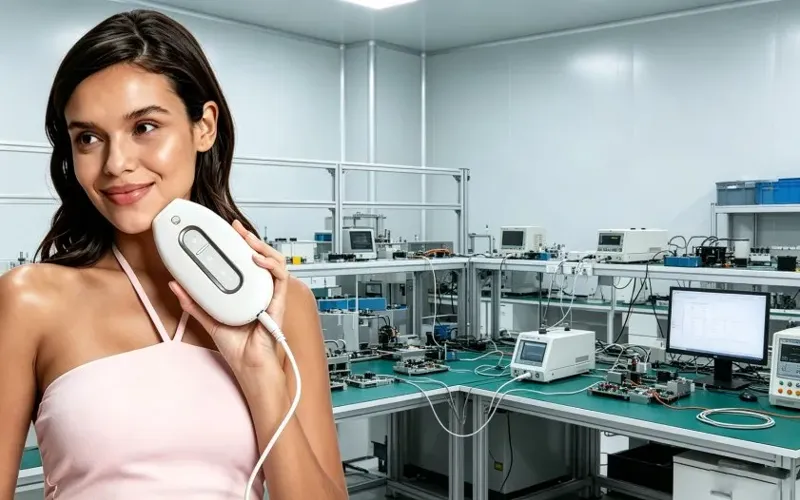
A French client recently sent us an inquiry. When I asked how he found us, his answer was short and direct: “GPT.”
He’s not alone. ChatGPT, Claude, and Gemini are all starting to bring clients straight to our door, and the volume of inquiries from these channels now far exceeds what organic search brings in. That’s a signal worth taking seriously.
In the past, we judged how clients found us mostly by Google. Customers got used to finding answers in the top five results of page one, so our SEO was built around that position. In 2026 the situation has changed: the first stop for B2B sourcing is now the AI chat interface, with Google, Bing, and Yahoo pushed behind it.
G2’s Answer Economy Report, published in April 2026, gives three numbers.
- 51% of B2B buyers start their purchasing process with an AI chatbot
- 69% of buyers have switched suppliers because of an AI recommendation
- 33% of buyers completed a purchase from a supplier they had never heard of before
AI is now doing the first-pass filtering of procurement directly. If your brand doesn’t show up in AI’s answers, you’ve been screened out before the buyer even starts searching.
The Backend Numbers: What Simple Analytics Shows
We want to keep this from staying anecdotal. Our own traffic dashboard, Simple Analytics, gives the numbers for June 8 to September 14, 2026. We removed 107 visits from mainland China — our own team and factory calibrating the site — which leaves 263 valid visitors from outside China.
Of those 263, 73 arrived through a ChatGPT recommendation: 61 with a chatgpt.com UTM tag and 12 as referrals. That is 28% of our non-China traffic in about fourteen weeks. ChatGPT is no longer a rounding error in our funnel.
The traffic is spread, not anchored in one market. Germany, the United States, France, the United Kingdom, Japan, Austria, the Philippines, India, Saudi Arabia, Canada, Israel, Russia, and Romania all appear in the list. Devices split 77% desktop to 23% mobile — the pattern of someone evaluating a supplier, not someone scrolling a phone in a queue.
Where people land tells the clearer story. The top five pages are the homepage, the products page, our Lumi 2 product page, the article on who should not use IPL hair removal, and the contact page. ChatGPT does not send people to a conversion page. It sends them to pages that answer a specific question — which device fits, who this is not for, how do I reach them.
That is the mechanism behind the 28%. The model cites pages that state something concrete and verifiable: a product page with real specifications, a safety article that honestly lists contraindications. When ChatGPT quotes it, the buyer clicks through to verify — and lands on a page that already answers the next question. Reference pages earn the citation; the citation earns the visit.
From Search Ranking to AI-GEO: The Sourcing Logic Has Completely Changed
The traditional B2B sourcing path ran through discover a need, search Google or Yahoo, browse websites, compare several suppliers side by side, send an inquiry, make the decision. Along that chain, SEO decided whether you squeezed into the top five search results.
The 2026 path has become discover a need, ask an AI directly, get a recommendation, verify the source yourself, inquire directly, make the decision. Where’s the difference? Traditional SEO competes on keyword density and link authority; AI recommendations compete on information credibility, structural clarity, and semantic match. Describe your need clearly — say, “I want to distribute an IPL hair removal brand” or “I want to build my own brand” — and the AI pushes suitable suppliers straight at you. You don’t even have to flip through web pages anymore.
That’s why GEO is starting to replace SEO as the new battlefield for B2B companies. SEO decides where you sit in the blue-link rankings. GEO decides whether you appear in the AI’s answer at all. The two dimensions are completely different.
Confidential Client Names: Why Do They Show Up in the FDA Database?
After the French client finished discussing the device specs, he asked another question: “If we work with iShine, we don’t want end consumers and the market to know you’re our supplier. Can you do that?”
Yes, we can. We sign NDAs with clients, and once signed, we honor them strictly. We never proactively announce which brand we’re supplying. The clients we publicize today — Costco, RoseSkinCo, Happyskinco, KU2 cosmetic — are all willing to have the supply relationship public. For clients who require confidentiality, we haven’t said anything in the past, and we won’t in the future.
The production side holds up too. The factory doesn’t accept unapproved visitors, so there’s no possibility of someone photographing a brand’s finished goods, semi-finished products, or packaging materials and posting them online.
But a sharp question follows. If it’s confidential, why does Shenzhen iShine Technology Co., Ltd.’s entry in the FDA database list “RoseSkinCo Lumi” under “light based over-the-counter hair removal - IPL Hair Removal Device,” alongside skn001, skn005, skn006, and skn002?
Fair question. The answer lies in the rules of FDA device listing — and in the brand’s own trade-off.
Under FDA rules, a Device Listing must state both the Labeler and the Manufacturer. Under 21 CFR 807, the Labeler is defined as “any person who applies a label to a device and intends to commercially distribute it.” That role can be the brand itself, or it can be the contract manufacturer.
One more detail. The FDA requires registration and listing information to be reviewed and refiled once a year, with the window fixed at October 1 to December 31 — even if nothing has changed, the process has to run anyway (see the FDA’s explanation of when to register and list). The record you found is one the factory has actively reviewed every year.
RoseSkinCo chose to hang “RoseSkinCo Lumi” directly under iShine’s FDA entry rather than filing a separate listing under its own corporate name. That was deliberate, for two reasons.
First, it sends a clear signal to regulators and consumers. FDA cleared is the threshold for entering the US market. By writing the brand name directly into the listed models, a consumer searching the FDA database immediately sees that the RoseSkinCo Lumi has received 510(k) clearance. That’s a highly efficient transfer of trust.
Second, it borrows search engines’ indexing logic. The FDA database is public, and search engines absorb these listing records. When consumers search “RoseSkinCo Lumi FDA cleared,” the FDA’s official page shows up directly in the results — carrying more weight than any paid ad.
A brand has to prioritize between confidentiality and market trust for itself. RoseSkinCo chose the trust side.
If your strategy is total invisibility, we can also file only generic model names like SKN-00X, with no brand identifiers at all. Technically it’s completely doable — the choice is purely the brand’s to weigh.
The Information Gain Principle: Why AI Inquiries Outperform Organic Search
More and more of the clients I meet here are GPT referrals, and the numbers in the backend back it up: inquiries from AI channels have already surpassed organic search inquiries. The change can be quantified. We recently adjusted our content strategy, intentionally or not, in a way that happens to match the preferences of AI citation models.
Google’s Unique Information Gain Score is becoming a key ranking factor. That score measures how much new, valuable information your content adds over existing sources. Pages with high information gain rank better in traditional search; large language models also prefer to cite pages whose information is unique, verifiable, and clearly structured.
What does this mean for you? You don’t need to pile on keywords. Just do three things well.
-
Give verifiable cases and data. For example, write on your site “monthly sales of 5,000 units — at that scale, many problems solve themselves.” That’s real, checkable data. AI trusts exact numbers; empty phrases like “great sales” it doesn’t trust.
-
Structure your information. FAQ Schema, Product Schema, and Organization Schema tell AI directly what’s on your page and can lift citation rates by 2 to 4 times.
-
Make information corroborate across multiple sources. When the same fact appears on three or more independent authoritative channels with consistent content, AI tags it as high-credibility information. We deliberately have our official site, industry media, and the FDA database telling the same story, corroborating each other — that trust chain is built on purpose.
Is Your Brand on AI’s Shortlist?
When 51% of B2B buyers put their first procurement stop on AI, and 68% of corporate purchasing decision-makers have already used AI search to complete preliminary screening before contacting any supplier, whether your brand has a place in AI search results stops being optional and becomes a hard gate for getting shortlisted.
The GEO optimization window is narrowing. Brands that build the trust chain first get a clear first-mover advantage. Those who don’t keep up won’t even have a chance to be seen.
Want to run a round of GEO optimization hands-on? Come to us anytime. Besides supplying IPL devices, we also have a full GEO playbook to help your brand hold onto visibility in the AI era.
Need a project-specific answer?
Talk to our manufacturing team
Contact the team to discuss your market, volume, compliance needs, and product direction.
Last updated
Did you find this article helpful?
Related articles