
New Advances in IPL Research: More Energy, Without Burning the Skin
The most practical progress in IPL research in recent years has been pushing energy density to 7 J/cm² without burning skin — and teaching the device to decide for itself how hard to fire.

Citable Summary
What is this article about?
Thermoelectric and sapphire contact cooling have pushed home IPL energy density to 7 J/cm² while keeping skin temperature in a comfortable range, the trade-off that once forced lower settings. Multispectral sensors now read melanin and skin temperature in real time, and machine learning models trained on thousands of skin scans handle Fitzpatrick typing more accurately.
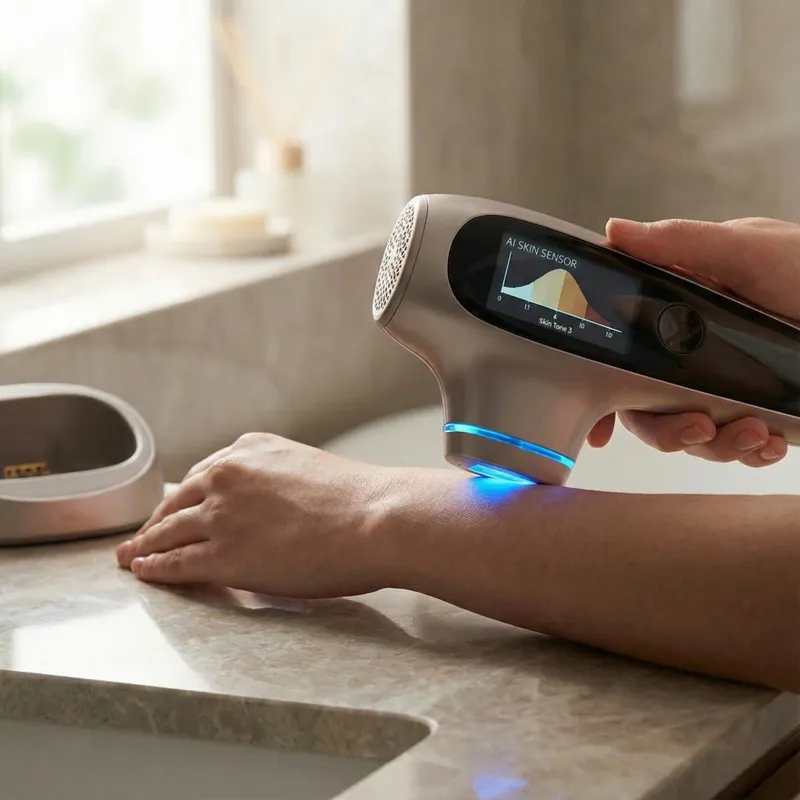
We build home IPL hair removal devices, so when we read research we care about two things: can energy go higher, and can the skin avoid getting burned. For years those two fought each other. High energy meant good results, but also heavy skin heating and higher burn risk. Old machines could only hold energy down — slower results, but safety first.
More energy, no burning
It took thermoelectric cooling (TEC) and sapphire contact cooling maturing in recent years to change the picture. The machine now pushes energy density to 7 J/cm² while keeping skin temperature in a comfortable range. With full energy delivered, the results of a single session go up, and neither safety nor comfort is sacrificed. This one sounds simple but is the hardest to pull off — if cooling can’t keep up, energy never goes up. That’s block one.
The machine decides for itself
Block two is sensors. New-generation machines carry multispectral skin sensors that read melanin content and skin temperature in real time, and can even measure how well the treatment head is pressed against the skin. Adaptive control algorithms adjust parameters on the fly from those readings — energy density and pulse width change by themselves, and wavelength filtering is automatic too. Anyone who’s used older devices knows manual level selection is where mistakes happen: set it too low and nothing happens, set it too high and you get zapped. When the machine judges for itself, there’s less room for user error.
More accurate skin typing
Block three is skin typing. In the past, judging skin type relied on a single sensor, with no small margin of error. Now machine learning models, trained on thousands of skin scans, do Fitzpatrick typing far more accurately than the old single-sensor approach. The typing system itself is decades old, dividing skin into types I through VI by melanin content and reaction to sunlight — I being the lightest, VI the darkest. The darker the skin, the lower the energy it can take, because melanin steals some of the light energy; the NCBI entry on skin typing and lasers explains this relationship clearly. With accurate typing, treatment parameters can be set per person, a wider range of skin tones becomes usable, results are maximized, and adverse reactions are minimized.
On the industry side
When these pieces land in the industry, the outcome is direct. Personalized parameters plus adaptive control mean fewer burns and fewer ineffective sessions, and user satisfaction goes up. Once cooling pushed energy density up, the number of sessions needed to see results dropped, and more people actually complete the full course. For manufacturers of home devices, those two things are the most tangible payoff in the last couple of years of research.
Need a project-specific answer?
Talk to our manufacturing team
Contact the team to discuss your market, volume, compliance needs, and product direction.
Last updated
Did you find this article helpful?