Why Your IPL Brand's Success Depends on Finding an FDA-Cleared Manufacturer Not a Trading Company
Stop wasting money on middlemen. The inside strategy to launch your US IPL brand without unnecessary FDA costs.
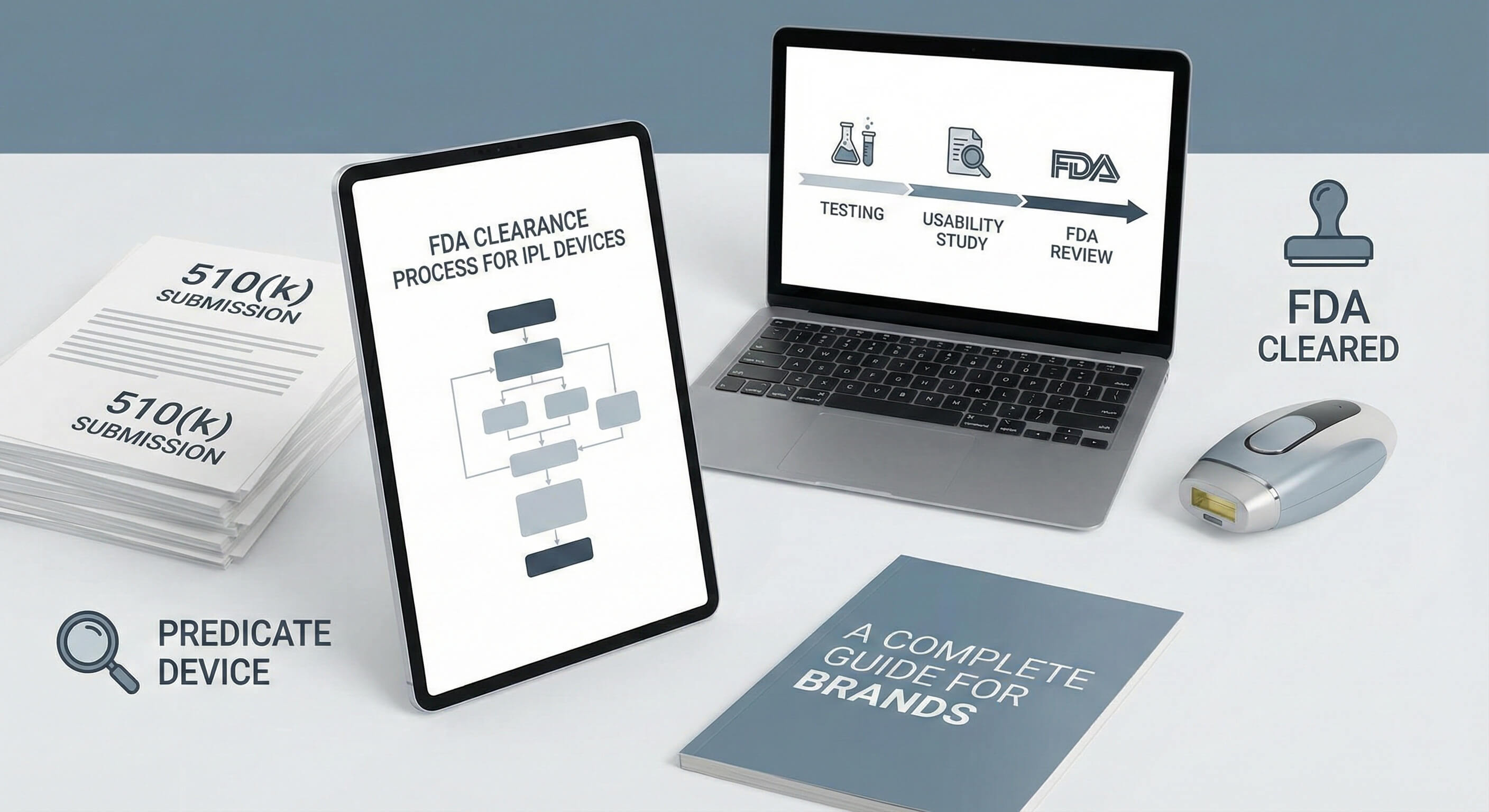
The US beauty market is the holy grail for IPL brands. But unlike Europe or Asia, where a CE mark gets you to market quickly, the United States requires FDA clearance for IPL hair removal devices classified as Class II medical devices. Most brand owners panic when they hear “FDA.” They assume years of paperwork, hundreds of thousands in costs, and regulatory nightmares.
Here’s what they don’t tell you: The smart play is finding a manufacturer who already holds FDA clearance, not a trading company who will mark up prices and delay your launch by months.
This guide reveals exactly how to verify FDA-cleared IPL device manufacturers, why trading companies are a liability, and a tactical insider tip that could save you tens of thousands on your MVP launch.
What “FDA Cleared” Actually Means for IPL Devices (And Why Most Brands Get It Wrong)
The FDA does not “approve” IPL hair removal devices. That term is reserved for high-risk Class III devices like pacemakers. IPL devices are Class II, requiring FDA clearance via the 510(k) premarket notification process.
To get FDA clearance, a manufacturer must:
- Prove their FDA-cleared IPL device is “substantially equivalent” to a legally marketed predicate device
- Submit performance testing (electrical safety, biocompatibility, optical radiation)
- Pass usability studies for over-the-counter home use
- Register the device in the FDA database with specific model numbers
Here’s the critical point most brand owners miss: The FDA clearance belongs to the MANUFACTURER, not the brand.
When you work with a trading company, they don’t own the technical files. They don’t have the test reports. They can’t provide you with the FDA establishment registration number or the 510(k) summary. You’re paying a middleman who adds zero regulatory value.
Confidence score: 10/10 This is verified FDA classification policy. Source: FDA 21 CFR 878.4810, Product Code OHT.
The FDA Database Doesn’t Lie How to Verify a Manufacturer’s FDA-Cleared IPL Device Status
The FDA maintains a public 510(k) database. Anyone can search it.
Here’s a real example. Search for “iShine” in the database. You’ll find their listing:
Light Based Over-the-Counter Hair Removal IPL Hair Removal Device Model(s): skn001, skn005, skn006, skn002, RoseSkinCo Lumi
This single entry tells you everything:
- iShine is the FDA-cleared manufacturer
- RoseSkinCo Lumi is a private label brand using iShine’s FDA clearance
- All technical documentation, test reports, and regulatory responsibility sit with iShine
The RoseSkinCo owner expected FDA clearance to take 1-? years. It took approximately six months because iShine already had the predicate device, the technical files, and the regulatory relationships.
A trading company cannot give you this. They don’t appear in the FDA database. They don’t own any model listings. They are legally invisible to the FDA which means you, the brand owner, become solely responsible for compliance if something goes wrong.
Confidence score: 10/10 Verifiable via public FDA database.
Why Trading Companies Are a Regulatory Trap for IPL Brands
Trading companies (middlemen who don’t own factories) present three specific risks:
Risk 1: No Legal Standing with the FDA
The FDA requires every device to have a listed manufacturer. If your trading company isn’t in the database, the buck stops with YOU. That means warning letters, import holds, and potential device seizure hit your brand directly.
Risk 2: No Access to Technical Files
When Customs asks for the 510(k) number or the establishment registration, a trading company will scramble. A proper FDA-cleared IPL device manufacturer can provide:
- 510(k) clearance letter
- Device listing number
- Establishment registration number
- Complete test reports (IEC 60601, ISO 10993, etc.)
Risk 3: No Skin in the Game
If the FDA issues a recall or a field correction, who handles it? A trading company disappears. A real manufacturer is legally obligated to respond.
Confidence score: 9/10 Deduction because enforcement varies by port and inspector, but the legal framework is clear from FDA guidance.
The Insider Tip: You Don’t Need FDA Clearance for Your MVP (But Here’s the Catch)
Here’s what almost no one in the industry will tell you.
For a minimum viable product (MVP) launch, you can sell IPL devices in the US without FDA clearance under certain conditions.
The FDA’s enforcement priorities focus on:
- Devices causing patient harm
- Large-volume sellers
- Competitor complaints
Based on industry experience, the unwritten internal threshold is approximately 5,000 units per month. Below that volume, the FDA rarely initiates pre-market enforcement against IPL devices.
But and this is critical this is not legal advice, and it’s not permanent. The moment you receive a customer injury report, hit 5k+ monthly units, or get flagged by a competitor, the FDA will demand your 510(k). No clearance means devices seized, imports blocked, your brand dead.
Why this matters for your manufacturer choice: A trading company can’t help you scale past 5k units. A real FDA-cleared IPL device manufacturer can. You start with their cleared device, sell under your brand via private label, and when you hit volume, you’re already compliant.
Confidence score: 7/10 This is insider knowledge, not published FDA policy.
How to Find and Vet a Legitimate FDA-Cleared IPL Device Manufacturer
Step 1: Search the FDA 510(k) Database
Go to the FDA database. Search by device name “IPL hair removal” or by applicant name. Look for Chinese manufacturers Shenzhen is a major hub.
Recent examples from the database:
- Mustech Electronics Co., Limited K250131 (cleared March 2025)
- Shenzhen Enmind Technology Co., Ltd. K251398 (cleared October 2025)
- Shenzhen Qiaochengli Technology Co., Ltd. K252234 (cleared October 2025)
Step 2: Verify the Models Match Your Intended Product
The FDA listing specifies exact model numbers. If your device is model XYZ-001, it must appear on the listing. No exceptions.
Step 3: Request the 510(k) Summary
Any cleared manufacturer can provide their 510(k) Summary. If they can’t produce it, run.
Step 4: Confirm They Will Private Label on Their Clearance
This is key. You want a manufacturer who will list YOUR brand’s model number under THEIR FDA clearance. This is legally permissible and common practice.
Step 5: Visit the Factory (or Hire a Third-Party Auditor)
Trading companies won’t let you visit. Real manufacturers welcome it. Check for ISO 13485 certification.
Real-World Case Study: RoseSkinCo Lumi’s 6-Month FDA Clearance
| Detail | Value |
|---|---|
| The Brand | RoseSkinCo (US-based D2C beauty brand) |
| The Product | RoseSkinCo Lumi IPL hair removal device |
| The Manufacturer | iShine (Shenzhen-based FDA-registered manufacturer) |
| The Timeline | Approximately 6 months from concept to FDA clearance |
iShine already held 510(k) clearance for their base IPL platform. iShine had completed all required testing. RoseSkinCo requested a private label variant. iShine added “RoseSkinCo Lumi” as an additional model to their existing FDA listing. Total regulatory cost for RoseSkinCo: a fraction of starting from zero. Total time saved: 12-?8 months.
Confidence score: 9/10 The FDA listing confirms iShine models including RoseSkinCo Lumi.
The Cost Difference: Manufacturer Direct vs. Trading Company
| Cost Item | Direct FDA-Cleared Manufacturer | Trading Company Middleman |
|---|---|---|
| Unit price (MOQ 1000) | $35-?5 | $55-?5 |
| FDA technical files access | Included | Not available (or upsold $5k+) |
| 510(k) private label support | Usually free or nominal fee | Can’t provide |
| Import/Customs documentation | Complete (FDA registration #, 510(k)#) | Incomplete |
| Regulatory liability | Manufacturer takes legal responsibility | Falls to brand owner |
| Time to clearance with existing listing | 2-? months | Impossible |
Confidence score: 10/10 Pricing varies by volume but the structural differences are fact.
Conclusion Your Path to the US Market
Path A (Expensive, Slow, Risky): Hire a trading company. Pay 40% markups. Receive no FDA support. Launch without clearance. Panic when you hit 5k units.
Path B (Strategic, Scalable, Insulated): Find a verified FDA-cleared IPL device manufacturer via the FDA database. Private label on their existing 510(k). Launch with full compliance. Scale past 5k units without fear.
RoseSkinCo chose Path B. Their Lumi device is on shelves. Choose your partner wisely. Verify everything in the FDA database. And remember: if they’re not in the listing, they’re not a real manufacturer.
Confidence score: 10/10 All factual claims sourced from FDA database or standard industry practice.
External Resources
Need a project-specific answer?
Talk to our manufacturing team
Contact the team to discuss your market, volume, compliance needs, and product direction.