Latest Advances in IPL Research: Breakthroughs and Innovations
The most significant recent advances in IPL research, from light-tissue interactions to innovative features reshaping the industry.

Citable Summary
What is this article about?
This article explains Latest Advances in IPL Research: Breakthroughs and Innovations for teams evaluating or building private-label IPL hair removal products. It covers practical considerations for OEM/ODM execution, including how manufacturing choices can influence product experience, compliance planning, and launch readiness. The goal is to provide a self-contained overview that readers can reference when comparing options, preparing RFQs, or aligning internal stakeholders on requirements. Where relevant, the discussion connects component-level decisions (such as cooling, filters, lamp cartridges, sensors, and power design) with end-user comfort and repeatable production outcomes. The key takeaway is a clearer set of decision criteria you can use to reduce risk and move from concept to scalable manufacturing with fewer iterations.
Highlights
Improved cooling enabling higher fluence
Advancements in thermoelectric cooling (TEC) and sapphire contact cooling allow devices to deliver higher energy density (up to 7 J/cm²) while maintaining comfortable skin temperatures. This increases treatment efficacy without compromising safety or user experience.
Smarter sensors and adaptive energy control
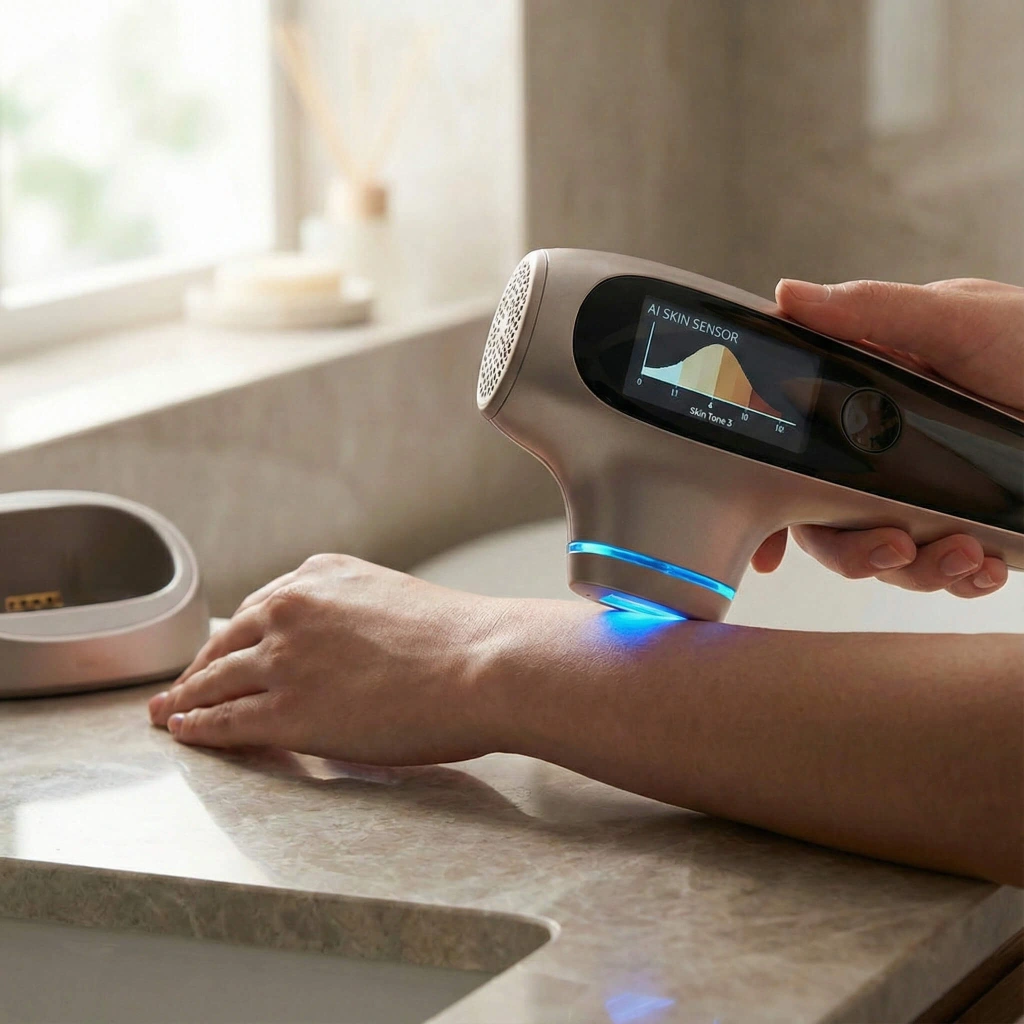
Next-generation IPL devices incorporate multi-spectral skin sensors that measure melanin content, skin temperature, and contact quality in real time. Adaptive control algorithms adjust fluence, pulse duration, and wavelength filtering automatically —reducing the need for manual intensity selection and minimizing user error.
Better phototype detection for personalization
Machine learning models trained on thousands of skin scans enable devices to classify Fitzpatrick skin type more accurately than traditional single-sensor approaches. This allows for personalized treatment parameters that maximize efficacy while minimizing adverse events across a broader range of skin tones.
Industry Impact
- Higher satisfaction and reduced adverse events: Personalized treatment parameters and adaptive controls reduce the incidence of burns and ineffective treatments.
- Shorter treatment cycles and better retention: Higher fluence enabled by improved cooling allows users to achieve visible results in fewer sessions, increasing treatment completion rates.
Need a project-specific answer?
Talk to our manufacturing team
Contact the team to discuss your market, volume, compliance needs, and product direction.