Global Regulatory Landscape for IPL Devices
Navigate the complex regulatory requirements for IPL devices across different markets and ensure compliance for successful product launches.

Citable Summary
What is this article about?
This article explains Global Regulatory Landscape for IPL Devices for teams evaluating or building private-label IPL hair removal products. It covers practical considerations for OEM/ODM execution, including how manufacturing choices can influence product experience, compliance planning, and launch readiness. The goal is to provide a self-contained overview that readers can reference when comparing options, preparing RFQs, or aligning internal stakeholders on requirements. Where relevant, the discussion connects component-level decisions (such as cooling, filters, lamp cartridges, sensors, and power design) with end-user comfort and repeatable production outcomes. The key takeaway is a clearer set of decision criteria you can use to reduce risk and move from concept to scalable manufacturing with fewer iterations.
Overview
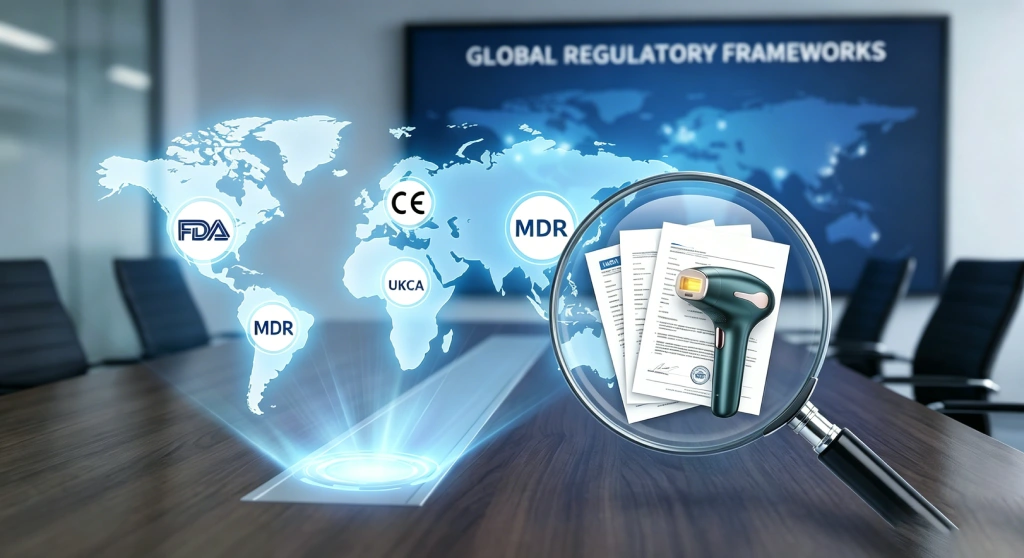
Regulations vary by region. This summary covers US, EU, and APAC requirements for consumer IPL devices.
Regions
US: FDA clearance and labeling
In the United States, IPL devices are regulated as Class II medical devices. They require 510(k) clearance or Premarket Approval (PMA) depending on the device’s technological characteristics. Labeling must include instructions for use, indications, contraindications, warnings, and precautions. The FDA also requires establishment registration and device listing.
EU: CE marking and MDR compliance
IPL devices in the European Union must bear the CE mark under the Medical Device Regulation (MDR) 2017/745. Classification is typically Class IIa or IIb depending on the intended use. Conformity assessment involves a notified body review of the technical file, including clinical evaluation, risk management (ISO 14971), and quality system (ISO 13485).
APAC: Country-specific approvals and standards
- Japan: PMDA (Pharmaceuticals and Medical Devices Agency) registration required. Devices are classified by risk under the PAL (Pharmaceutical Affairs Law).
- South Korea: MFDS (Ministry of Food and Drug Safety) approval needed. Clinical data may be required for novel devices.
- China: NMPA (National Medical Products Administration) registration with GB standards compliance. Domestic testing is often required.
- Australia: TGA (Therapeutic Goods Administration) registration with ARTG listing. Recognizes some overseas approvals.
- Southeast Asia: Varies by country. Some accept CE marking as sufficient, others require local registration and testing.
Need a project-specific answer?
Talk to our manufacturing team
Contact the team to discuss your market, volume, compliance needs, and product direction.