The Science of IPL: How Light Targets Hair Follicles
Understanding the scientific principles behind IPL technology and how it effectively targets and reduces unwanted hair.
Intense Pulsed Light (IPL) technology has revolutionized hair removal and skin treatments by offering a non-invasive alternative to traditional methods. But how exactly does IPL work at a scientific level? This article explores the fascinating physics and biology behind IPL technology and explains why it's so effective at targeting hair follicles.
The Physics of Light and Hair
Understanding Light Absorption
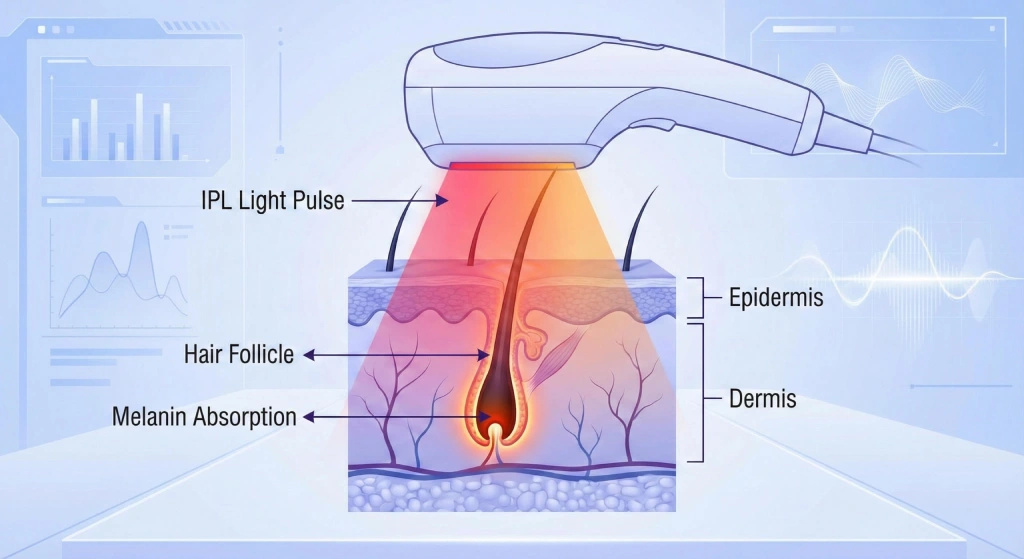
The effectiveness of IPL technology is based on the principle of selective photothermolysis, a process where specific wavelengths of light are absorbed by target chromophores (light-absorbing molecules) in the hair and follicle. The key chromophore in hair removal is melanin, the pigment that gives hair its color.
Key Scientific Principle:
Melanin absorbs light energy most effectively in the wavelength range of 600-1200nm, which is precisely the spectrum used by IPL devices. This selective absorption ensures that the light energy targets the hair follicle while minimizing damage to surrounding skin tissue.
The Role of Melanin
Melanin exists in two primary forms in human hair:
- Eumelanin: Responsible for black and brown hair colors, highly effective at absorbing IPL wavelengths
- Pheomelanin: Found in red and blonde hair, less effective at absorbing IPL light energy
This difference in melanin types explains why IPL is most effective on darker hair colors and why blonde, red, or gray hair responds poorly to treatment.
The Hair Growth Cycle and IPL Timing
Understanding Hair Growth Phases
Hair growth occurs in three distinct phases, and IPL effectiveness varies depending on which phase the hair is in:
Anagen Phase
Duration: 2-7 years
Active growth phase where hair is connected to the follicle and contains the most melanin. IPL is most effective during this phase.
Catagen Phase
Duration: 2-3 weeks
Transitional phase where hair stops growing and begins to separate from the follicle. Limited IPL effectiveness.
Telogen Phase
Duration: 3-4 months
Resting phase where hair is no longer connected to the follicle. IPL has minimal to no effect during this phase.
Since only 10-15% of hair is in the anagen phase at any given time, multiple IPL sessions are required to target all hair follicles as they cycle through the growth phases.
The IPL Treatment Process
Step-by-Step Light Interaction
Light Emission
The IPL device emits broad-spectrum light (typically 500-1200nm) through a filtered flash lamp.
Skin Penetration
Light passes through the epidermis and reaches the hair shaft and follicle in the dermis (1-4mm depth).
Melanin Absorption
Melanin in the hair shaft and follicle absorbs the light energy and converts it to heat.
Thermal Damage
Heat damages the follicle structure, particularly the dermal papilla and matrix cells responsible for hair growth.
Hair Shedding
Damaged hair falls out within 1-3 weeks, and the follicle's ability to produce new hair is reduced or eliminated.
Factors Affecting IPL Effectiveness
Skin and Hair Characteristics
| Factor | Optimal Conditions | Challenging Conditions |
|---|---|---|
| Hair Color | Black, dark brown | Blonde, red, gray, white |
| Hair Thickness | Coarse, thick hair | Fine, vellus hair |
| Skin Tone | Light to medium (Fitzpatrick I-IV) | Dark skin (Fitzpatrick V-VI) |
| Hair Density | High density areas | Sparse hair distribution |
Technical Parameters
Several technical factors influence IPL effectiveness:
- Wavelength Range: Optimal range of 600-1200nm for hair removal applications
- Pulse Duration: Typically 1-100ms, must be shorter than the thermal relaxation time of the follicle
- Energy Density (Fluence): Usually 10-50 J/cm², adjusted based on skin type and hair characteristics
- Pulse Interval: Time between pulses affects heat dissipation and treatment comfort
- Spot Size: Larger treatment windows allow for faster coverage but may reduce precision
Safety Mechanisms and Skin Protection
Cooling Systems
Modern IPL devices incorporate cooling mechanisms to protect the epidermis:
- Contact Cooling: Sapphire or quartz cooling tips that conduct heat away from the skin surface
- Cryogen Spray: Pre- and post-pulse cooling with cryogenic spray
- Air Cooling: Forced air circulation to reduce surface temperature
Skin Tone Detection
Advanced IPL devices include skin tone sensors that automatically adjust energy levels or prevent treatment on skin tones that are too dark for safe IPL application. This prevents burns and hyperpigmentation in darker skin types.
Optimizing Treatment Outcomes
Treatment Protocol
For optimal results, IPL treatments should follow these scientific principles:
- Treatment Intervals: 4-8 weeks apart to target hair in different growth phases
- Session Count: 6-12 sessions typically required for significant hair reduction
- Pre-treatment Preparation: Shaving 24-48 hours before treatment to optimize light absorption
- Sun Avoidance: Avoiding sun exposure before and after treatment to prevent complications
- Energy Progression: Gradually increasing energy levels as skin tolerance develops
Measuring Success
Treatment success is typically measured by:
- Hair Count Reduction: 70-90% reduction in hair count after complete treatment series
- Hair Diameter Reduction: Remaining hair becomes finer and lighter in color
- Growth Rate Reduction: Slower regrowth of remaining hair
- Treatment Area Coverage: Uniform results across the entire treatment area
Future Developments in IPL Science
Ongoing research in IPL technology focuses on improving effectiveness and expanding treatment capabilities:
- Wavelength Optimization: Development of more precise wavelength filtering for specific hair and skin types
- Pulse Shaping: Advanced pulse patterns that optimize energy delivery while minimizing discomfort
- Combination Therapies: Integration with radiofrequency or other energy modalities for enhanced results
- AI-Guided Treatments: Machine learning algorithms that optimize treatment parameters in real-time
- Improved Cooling: Next-generation cooling systems for enhanced comfort and safety
Conclusion
The science behind IPL hair removal is based on well-established principles of physics and biology. By understanding how light interacts with melanin in hair follicles, manufacturers can develop more effective devices, and users can achieve better treatment outcomes.
The key to IPL success lies in the precise application of scientific principles: selecting appropriate wavelengths, optimizing energy delivery, timing treatments with hair growth cycles, and implementing proper safety measures. As our understanding of these mechanisms continues to evolve, IPL technology will become even more effective and accessible.
For manufacturers and brands in the IPL industry, staying current with the latest scientific developments is crucial for developing competitive products that deliver superior results while maintaining the highest safety standards.
Dr. Sarah Chen
Stay Updated
Get the latest IPL manufacturing insights and industry trends delivered to your inbox.
We respect your privacy. Unsubscribe at any time.