OEM or ODM: How to Choose for Your IPL Hair Removal Device
What's the difference between OEM and ODM, how much money and time each costs, and who each one suits. Using brand projects iShine has served to lay out both paths clearly.
Citable Summary
What is this article about?
OEM development plus tooling starts at $80,000 and rises with no ceiling, while ODM lands between $30,000 and $100,000, the loudest difference between the two paths. Tooling alone runs $20,000 to $50,000, minimum order quantities start at 500 units for ODM against 1,000 for OEM, and ODM reaches market in 2 to 9 months.
The beauty tech market has been growing fast in recent years, and the IPL hair removal device is one of the most hotly contested consumer products in it. When a brand wants to enter, the first decision to make is how to work with a factory. The two most common models in the industry are OEM and ODM. The acronyms differ by a single letter, but the money, time, and risk are completely different stories.
Our team at iShine does both. International names like Cyden, Costco, and Haier are our ODM clients, and growing beauty brands like MandySkin and HappySkin have also taken custom solutions from us. Below, I’ll walk through both paths based on projects we’ve actually done.
What OEM is
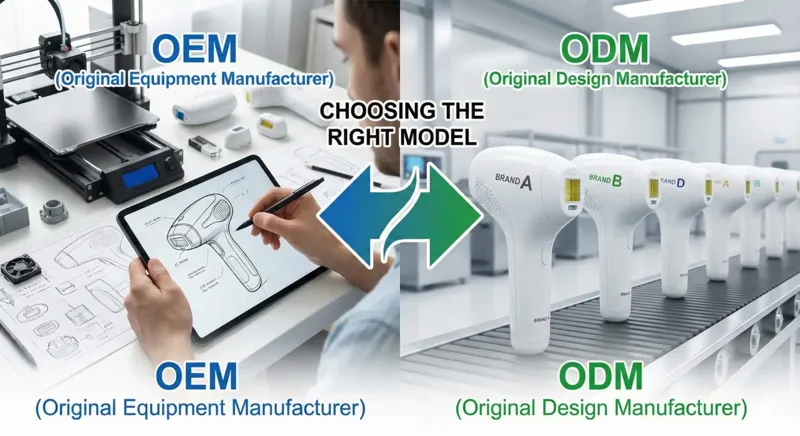
OEM stands for Original Equipment Manufacturer — contract manufacturing, in plain terms. The brand provides the design, the factory provides the capacity. The brand hands the factory the specification sheet, technical requirements, and complete drawings, and the factory builds the machines. Design rights, specs, features, and performance all stay in the brand’s hands. The price is high development costs and a long timeline, generally 6 to 12 months; the payoff is huge room for customization, so the product can grow into exactly what the brand wants.
What ODM is
ODM stands for Original Design Manufacturer — design-based contract manufacturing. The factory holds ready-made product platforms, or develops new product concepts based on market demand. The brand customizes on top of our existing platform, rebrands, and goes to market. The base design sits with the factory; what the brand can change is exterior styling, colors, logo, packaging, instruction manuals, and accessory combinations.
ODM’s biggest advantage is speed — you can generally hit the market in 2 to 9 months — and the upfront investment is small. More importantly, we’re willing to share design rights and intellectual property with brand partners and invite them to work out business development models for specific regions worldwide together with us. That means you don’t have to buy the design outright in one lump; you can build your own product moat step by step over the course of the partnership.
The two side by side
| Aspect | OEM | ODM |
|---|---|---|
| Design ownership | Brand owns the complete design | Factory owns the base design, shareable with the brand |
| IP ownership | Brand-exclusive | Negotiable — shared or bought out |
| Development timeline | 6 to 12 months | 2 to 9 months |
| Development and tooling investment | $80,000 to $250,000+ | $30,000 to $100,000 |
| Minimum order quantity | 1,000 to 5,000 units | 500 to 5,000 units |
| Customization room | Fully custom | Limited to preset options |
| Risk | Higher — design not yet validated | Lower — design already validated |
Put the two columns side by side and the investment is the loudest difference. OEM development plus tooling starts at $80,000 and goes up with no ceiling; ODM gets you going for $30,000 to $100,000.
The minimum order quantity differs too — ODM can start a line at 500 units, while OEM generally starts at 1,000. The reason isn’t complicated: OEM tooling and production lines are opened specifically for your product, so small volumes can’t spread the cost.
Tooling fees and BOM costing
Let me clear up a common misunderstanding here. Development fees and tooling fees are not the same as unit price.
Tooling is a one-time investment. Opening a set of injection molds for an IPL device housing typically runs $20,000 to $50,000, depending on how complex the product structure is, how many cavities the mold has, and what surface finishing is required.
Per-unit cost is set by the BOM (Bill of Materials). Only after the specs and suppliers of every component — housing, lamp cartridge, capacitors, circuit board, optical filter, fan, power adapter — are locked down can you calculate an accurate unit price. Different designs make very different demands on components; some aggressive designs need non-standard components, and costs climb noticeably.
Today our unit prices range from $20 to $58, and this is exactly why the spread is so wide. Standard platforms use standard parts and costs stay controlled; custom designs use non-standard parts that perform better but cost more.
Development fees and tooling fees are the threshold at the front; BOM material cost is the long-term ledger. Once both accounts are clear, you know which model actually fits you.
When to choose OEM
The precondition for OEM is that you have a concrete product idea, nothing on the market fits, or you want to build something nobody else has. The reasons boil down to a few types. The innovation has to be obvious, or the product carries proprietary technology; the differentiation has to be strong enough to compete — if it looks like everyone else’s, there’s nothing to fight with; or your target market has special regulations that a standard solution can’t pass. Clients like this usually have mature channels and large order volumes, treat the product line as a long-term business, and price toward the premium end. The more of these conditions you hold, the more you should keep design and development in your own hands.
Our work with MandySkin is a typical OEM case. They wanted an IPL hair removal device for sensitive skin, and their requirements were very specific. Custom filtering to reduce skin irritation; a redesigned handle grip; their own cooling system; and a mobile app for treatment tracking. None of these four could be faked by tweaking parameters — they had to be redone from the design end. The finished product became their flagship, with customer satisfaction 40% higher than standard IPL hair removal devices.
When to choose ODM
Clients who choose ODM usually have practical goals. Those in a hurry to enter — the 2 to 9 month launch timeline fits exactly, and they can’t wait out OEM’s 6 to 12 months. Companies without an in-house R&D team whose development capability has never been strong — same fit. Budget-constrained brands that want to keep upfront investment minimal and spend the money on marketing and brand instead. And a more cautious type: test the market with a ready-made product first, validate demand, and only then decide whether to invest heavily in custom development.
HappySkin is a startup beauty brand whose crowdfunding window was locked — the product had to launch within 3 months. OEM couldn’t fit that schedule, so they picked a device from our mature platform, which had a 95% customer satisfaction rate at the time. They changed the exterior and color scheme, added their own branding and packaging design, and swapped the app interface to the version they were used to. It launched in 10 weeks, blew past its crowdfunding goal by 300%, and held the market.
In ODM projects, we also share design rights and intellectual property with brand partners and invite them to work out business development models for specific regions worldwide together with us — so brands build their own product moat step by step instead of finishing a project and finding nothing left to keep.
The hybrid model
Many mature brands take a third path: enter with ODM first, then switch to OEM once they’re established.
Phase one: launch with a ready ODM solution and grab market share. Collect customer feedback and market data along the way, build brand awareness and channels, and let the revenue from sales fund later development.
Phase two: switch to OEM, develop custom features based on market feedback, create your own selling points, accumulate proprietary technology, and finally push the product to a premium position.
No matter which model, these things can’t be skipped
Give the numbers on technical specs first.
| Parameter | Requirement |
|---|---|
| Wavelength range | 590 to 1200 nanometers |
| Energy density | 3 to 6 joules per square centimeter, adjustable intensity |
| Pulse duration | 1 to 10 milliseconds, matching different skin and hair types |
| Cooling method | Contact cooling or air cooling |
| Safety configuration | Skin tone sensor, UV filter, auto power-off |
Certification is another hard gate, and you should ask about it before choosing a factory. Entering the US market requires FDA clearance; entering Europe requires the CE mark, now governed by the MDR regulation — Regulation (EU) 2017/745 has been mandatory since May 26, 2021; FCC certification covers electromagnetic compatibility. ISO 13485 is the medical device quality management system, and IEC 60601 is the safety standard for medical electrical equipment — all of these follow medical device requirements. If a factory can’t produce any of these certificates, don’t touch it no matter how low the quote.
The quality system needs clarifying in advance too. Incoming material inspection — every component checked against spec; in-process monitoring of critical parameters during assembly; full-unit performance and safety testing on finished products; reliability testing with accelerated aging plus stress testing to see long-term behavior; and packaging validation to make sure nothing breaks in transit. Skip any of these five steps and it will come back to bite you in the goods.
Money and time, two ledgers
First the OEM side.
| Item | Amount |
|---|---|
| Development fees | $50,000 to $200,000 |
| Tooling fees | $20,000 to $50,000 |
| Unit cost (BOM + manufacturing) | $20 to $58, depending on volume |
| Minimum order quantity | 1,000 to 5,000 units |
| Break-even timeline | Typically 12 to 18 months |
Now the ODM side.
| Item | Amount |
|---|---|
| Custom development and adaptation fees | $10,000 to $50,000 |
| Tooling amortization | $20,000 to $50,000 |
| Unit cost (BOM + manufacturing) | $20 to $58, depending on spec |
| Minimum order quantity | 500 to 5,000 units |
| Break-even timeline | Typically 6 to 12 months |
Put the two ledgers together and the pattern is clear. OEM spends the big money up front — development plus tooling, starting at $80,000, with break-even at one to one and a half years. ODM is much lighter at the start: custom development at $10,000 to $50,000, tooling at $20,000 to $50,000, so $30,000 to $100,000 total gets you going, with break-even in six months to a year.
Unit price lands in the $20 to $58 range for both models; the wide spread comes from BOM differences. Standard platforms use standard parts and costs stay controlled, while aggressive designs need non-standard components and cost more. ODM’s unit price isn’t necessarily higher than OEM’s — it all depends on the specific configuration.
How to pick a factory
When we evaluate a partner factory internally, we look at three areas.
First, technical capability. Whether the R&D team is in-house, whether there’s prior experience building IPL devices, and whether the testing and validation facilities are advanced enough — these directly decide whether development can land. Track record in beauty device manufacturing and the ability to handle regulatory compliance are the two easiest things to read a factory’s fundamentals from.
Second, manufacturing. Whether they hold ISO certification, how complete the quality management system is, production capacity flexibility, and supply chain management capability — these directly determine whether goods ship on time and in full.
Third, the way they work with you. Whether project communication and process management are transparent, whether cooperation models and commercial terms can be negotiated flexibly, whether they’re in it for the long haul or one order and done, and whether after-sales support keeps up after launch.
Where the industry is going
The changes in IPL manufacturing have been pretty visible over the past few years.
| Direction | Current state |
|---|---|
| Smart connectivity | IoT and app integration becoming standard |
| Personalization | AI tailoring treatment plans from skin analysis |
| Sustainability | Eco-friendly materials, energy-efficient designs |
| Miniaturization | Smaller, more portable devices for travel |
| Multi-functionality | IPL combined with other beauty functions |
| Enhanced safety | More advanced skin tone detection, real-time monitoring |
These trends will directly define what the next generation of products looks like. When you pick a partner factory, ask along the way whether they have reserves in these directions.
How to decide
The criteria are just a few lines.
The conditions for OEM are hard requirements. The product needs to be unique; you can put up $100,000+ in development investment; order volume can reach 1,000 units and up; and you can wait out a 6 to 12 month development cycle. The more decisive differentiation is to you, the less you should hesitate.
ODM is a different set. You only have 2 to 9 months to launch, the development budget is limited, you’d rather use validated designs directly and put your energy into marketing and brand, and you don’t want to shoulder technical risk yourself. And in ODM projects, the factory is willing to share design rights and intellectual property with the brand and invite the brand to work out business development models for specific regions worldwide together — which means you don’t need to buy the design outright to build your own product moat step by step during the partnership.
After all these years, my view is simple. If you’re in a hurry and budget-limited, take the market with ODM first and accumulate brand assets and product knowledge along the way; if you hold an original idea and have both the money and the time, go OEM. The two paths don’t conflict — we’ve seen plenty of clients go ODM first and OEM later.
Need a project-specific answer?
Talk to our manufacturing team
Contact the team to discuss your market, volume, compliance needs, and product direction.
Last updated
Did you find this article helpful?
Related articles